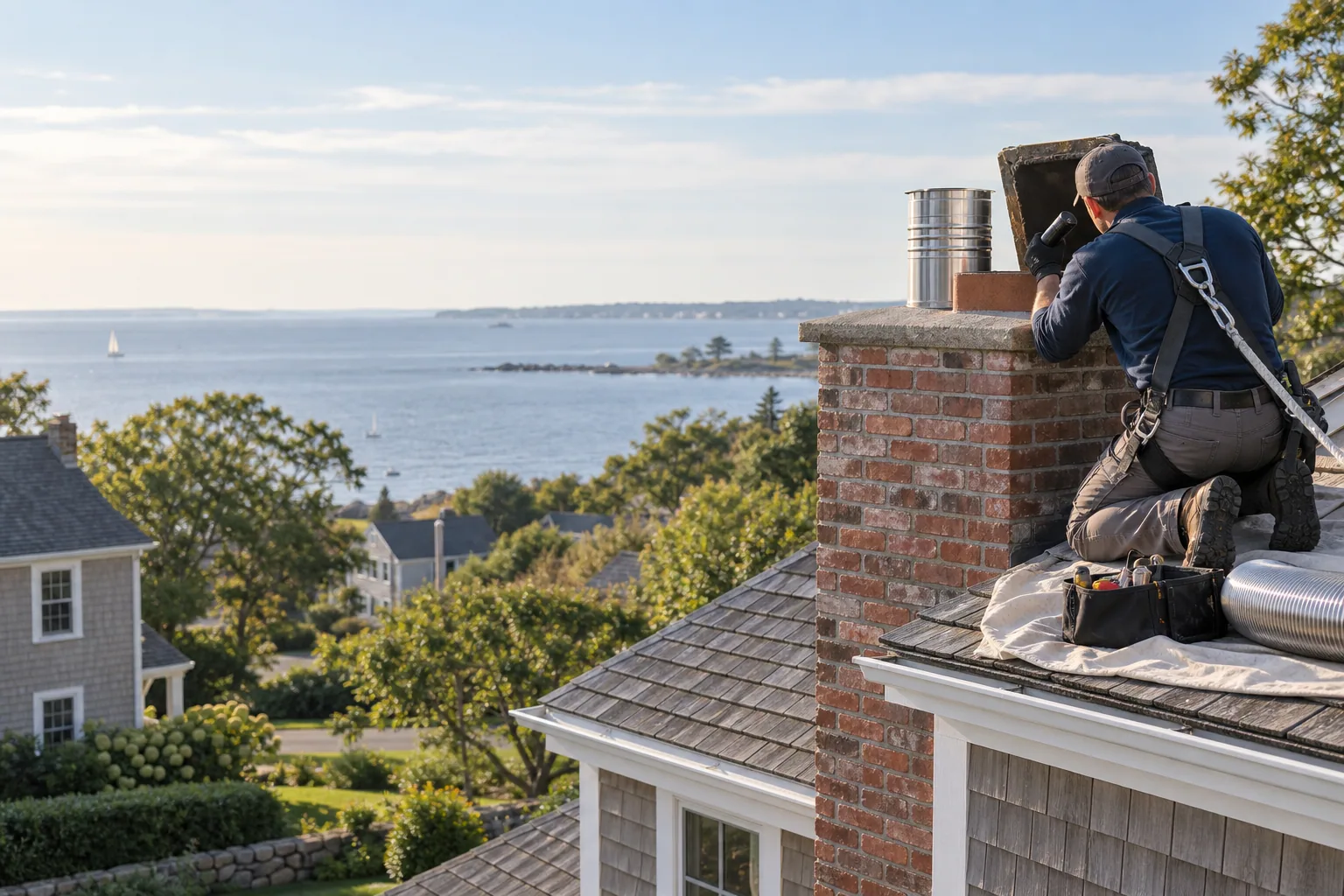
Fairfield Elite Chimney provides independent planning information and quote routing for Danbury, roughly 28 miles from Fairfield. Danbury is the largest inland Fairfield County city, carrying mill-era downtown housing, postwar subdivisions, and colder inland winters that change chimney and liner planning after inspection. A qualified local provider must inspect the real appliance, flue and work area before confirming a method, safety conclusion or price.
A Danbury property record comes before a product choice
Danbury’s size and age range mean a single description rarely covers the whole city. Record fireplaces, stoves, furnaces, boilers, water heaters, connectors, thimbles, cleanouts and roof terminations that can be identified safely. Mark active, uncertain and apparently abandoned passages rather than guessing which chimney serves which appliance.
Danbury field notes that should travel with the request
Danbury grew around a hat-manufacturing economy, and its downtown and near-downtown blocks still carry the multi-family and mixed-use buildings that housed that industrial workforce, often with masonry chimneys dating to the same period. Outward from that core, ranch, split-level and colonial streets expanded across the hillsides during the postwar decades as the city grew into Fairfield County’s largest inland population center. A chimney built for a coal or early oil furnace in one of the older downtown buildings may now carry a smaller gas appliance, and the oversized passage left behind does not correct itself without a liner sized to the current input.
Danbury sits well north and inland within Fairfield County, at a higher elevation and farther from Long Island Sound than the county’s shoreline towns, so winters run colder and the heating season runs longer here than in a coastal town of the same age. That inland exposure means condensation inside an oversized or poorly insulated flue, rather than salt-air corrosion, is the more common finding during a Danbury inspection. A Level 2 inspection is frequently requested ahead of a Danbury home sale, refinance or insurance renewal, and that written record should trace the exact passage serving the current appliance rather than assume continuity from the building’s original heating system. Note any fuel conversion date, the appliance it replaced and any liner work already completed so the inspector is not re-diagnosing a passage that was already corrected.
Use local building form to plan access, not diagnose the liner
Send ground-level photographs and describe ordinary access constraints for the Danbury property, including whether the building is a single-family home, a multi-family downtown property or a larger hillside lot. Roof pitch, height, landscaping and neighboring structures can affect setup, but they do not reveal hidden joints, corrosion, deposits or clearances inside the chimney.
Inspect and label the complete Danbury venting route
Ask the provider to identify the appliance, fuel, input, connector, current liner material, visible dimensions, height, offsets, cracks, gaps, deposits, corrosion, staining and viewing limits. A useful camera sequence names its direction and location. Start with the liner inspection guide and use the Level 2 inspection guide when a transfer, system change or significant event calls for broader documentation.
After every stack carries a number and a matching camera record, the chimney liner installation page picks up from there, walking through sizing, insulation, connections and the sign-off that ends the project.
Keep liner, masonry and water-entry scopes separate in Danbury
A liner is the internal venting passage. Crown, cap, flashing, brick, mortar, smoke chamber, firebox, connector and appliance are related but distinct components. Ask each Danbury proposal to say what is included, excluded and still undecided.
Choosing between a stainless sleeve and a poured liner in Danbury
Neither an older downtown building nor a colder inland setting settles whether a sleeve or a poured system belongs in a given chimney; that decision follows the camera, not the neighborhood. Put the stainless steel chimney liner option side by side with the cast-in-place chimney liner option only once the appliance, the flue’s measured dimensions and whatever material already lines it are written down. A flue that runs mostly straight, or carries only a mild offset, tends to accept a flexible stainless sleeve, including the narrower passage a fuel conversion often leaves behind, while a flue that has gone noticeably out of round, cracked through or lost structural soundness tends to need cast-in-place work instead. If the camera turns up a liner that is otherwise fine apart from one isolated problem spot, check the liner repair guide before assuming a full replacement is the only path forward.
Confirm the current Danbury municipal path
Danbury reviews chimney, venting and appliance work under the Connecticut State Building Code, and a permit question for a specific parcel should go to the city’s current building office rather than be assumed from a neighboring town’s rules. Requirements can change and can differ for internal relining, visible exterior work and appliance replacement. Do not copy an approval path from Fairfield or another nearby town onto a Danbury address.
Compare Danbury proposals in homeowner decision bands
Place the same inspection record beside every proposal. Compare inspection and preparation, liner system and components, access and connections, then permits and closeout. The cost guide shows those bands without pretending an online range is a property-specific quote.
Keep the finished Danbury record with the home
Retain the appliance data, before-and-after images, product identity, sizing basis, insulation, connections, permit and inspection record, operating checks, invoice and warranty. A future owner or technician should be able to see what changed and why.
Build a useful Danbury intake packet
Start with the full Danbury address and identify whether the property is a single residence, multifamily building or another occupancy. List each fireplace, stove, furnace, boiler and water heater that may connect to masonry. For every active appliance, record the fuel, model information that can be read safely, visible connector route and any recent replacement or conversion. Attach earlier camera reports, permits, invoices and product documents instead of summarizing them from memory.
Photograph the chimney exterior, appliance connection and cleanout only from safe standing locations. Note ordinary access facts such as gates, narrow side yards, shared drives, protected landscaping and known parking limits. The provider, not the homeowner, should decide how to access a roof or concealed area safely. These notes help plan a Danbury visit; they do not establish liner condition.
Keep symptoms factual until the route is inspected
Dates and operating conditions make observations more useful. Write “odor noticed after the furnace started,” “debris found near the cleanout,” or “staining appeared after rain” rather than choosing a cause. Similar symptoms can come from different parts of the chimney, appliance, connector or exterior envelope. The inspection and proposal should show which evidence supports the recommended Danbury scope and which questions remain open.
Review the Danbury closeout before the provider leaves
Match the completed work to the original flue label, appliance and written scope. Collect product identity, installation images, connection details, inspection outcome, permit record when applicable, operating checks, invoice, warranty and any monitoring instructions. If work changed after discovery, retain the written reason and revised scope. That file should allow another qualified person to understand what was inspected, what was installed or repaired, and what was deliberately left outside the project.
For follow-up, share the Danbury address, appliance, symptoms and existing records. The site routes the request to a local provider; it does not offer emergency dispatch or remote clearance.
Nearby, Shelton and New Canaan each answer to their own parcel records and local rules, and Wilton and Fairfield sit farther south along the same inland-to-coastal stretch of the county, so check the matching guide before carrying a Danbury answer somewhere else. Just north, Brookfield adds Candlewood Lake cottages to the same colder inland pattern and keeps its own municipal path, and New Fairfield carries that lake context farther north around Candlewood Lake and Squantz Pond with seasonal homes reopened after idle winters, with Sherman the northernmost town of all along the lake’s upper arm and its antique farmhouse flues, while just west, Ridgefield carries antique Main Street colonials and larger wooded lots under its own separate building office. East of Danbury, Newtown spreads a similar Main Street village and large-lot pattern across more glacial-till acreage under its own building department. Between the city and Newtown, Bethel combines a smaller village center with residential streets and its own Building Department confirmation. For the rest of this site’s Connecticut coverage, browse the service area directory.
Official and technical sources
- City of Danbury
- Connecticut State Building Code
- Connecticut Residential Code Chapter 18, Chimneys and Vents
- Connecticut home-improvement guidance
- CSIA relining training overview
Matching an appliance to the flue in Danbury? Compare oil furnace chimney liners and chimney liner insulation as part of the selected system before approving a Danbury scope.
Frequently asked
01Does a Danbury mailing address prove which office handles the work?
No. Confirm the parcel, municipality, appliance and complete work description with the current local authority.
02Can an exterior photo diagnose a Danbury chimney liner?
No. Exterior images help plan access, while the appliance and internal passage require direct inspection.
03Does Danbury's colder inland climate change how a liner is sized?
Not by itself. A longer heating season can affect condensation and draft behavior, but the connected appliance input and the flue's actual dimensions still decide the liner size and material.
04Does a Danbury home's downtown or postwar location decide the liner material?
No. Construction era is a starting clue, not a verdict. The camera inspection of the actual flue decides whether a sleeve or a poured liner fits.
05What should be included with an assessment request?
Share the address, appliance and fuel, symptoms, prior reports, known liner history and ordinary access notes.