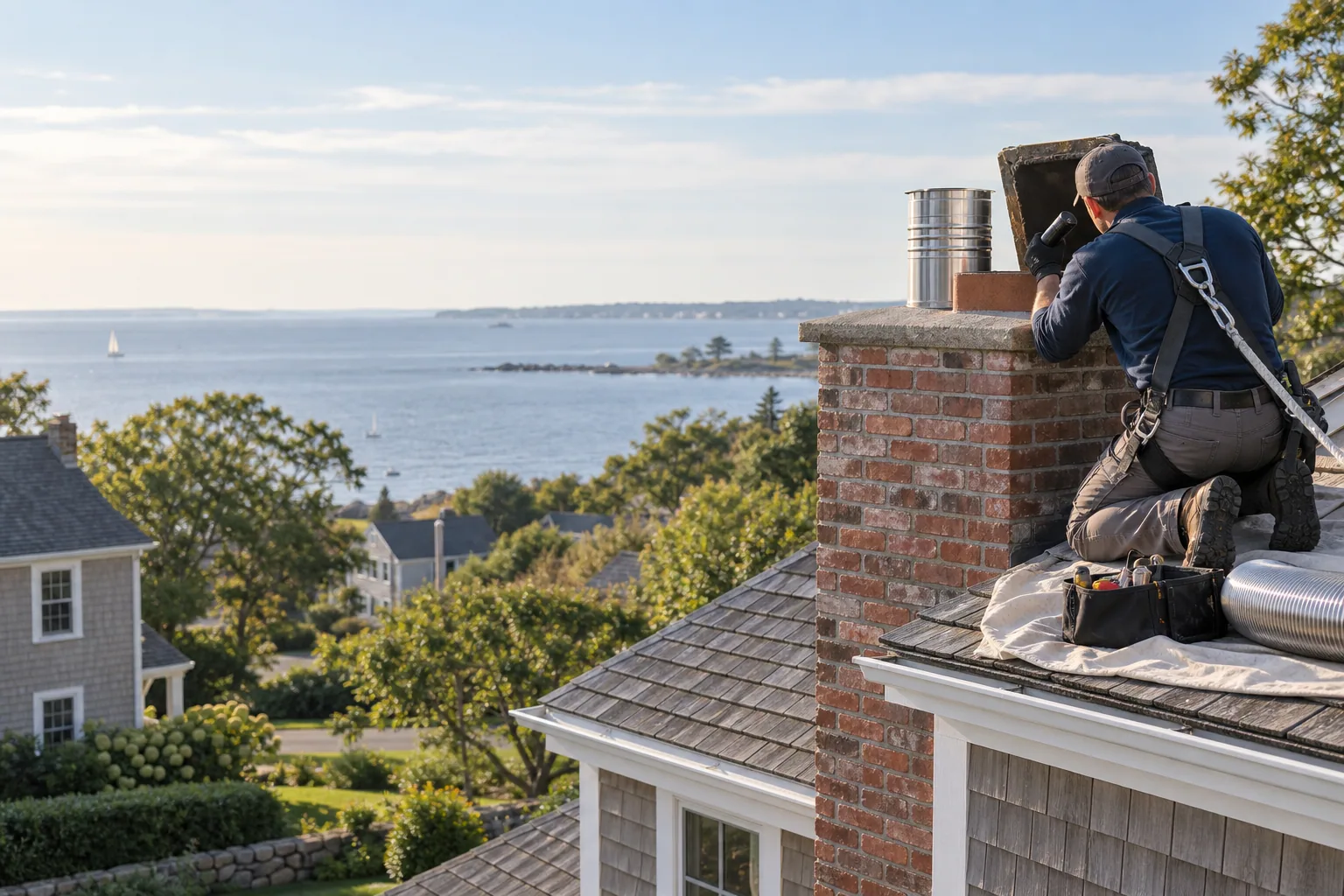
Fairfield Elite Chimney offers independent chimney planning information and quote routing for Sherman, roughly 40 miles from Fairfield. Sherman is the northernmost and least populous town in Fairfield County, sitting above New Fairfield along the northern arm of Candlewood Lake and running up to the New Milford line. Its housing is rural: antique farmhouses and center-chimney colonials on country roads, scattered lake cottages and weekend homes along the water, and newer houses tucked into wooded acreage. A qualified local provider needs to examine the appliance, deposits, interior passage and exposed masonry before recommending cleaning, liner work or repairs.
Check an antique Sherman farmhouse flue before trusting the original chimney
Many Sherman houses predate modern venting practice, and an original center chimney may still carry smoke through a passage that was never relined. Age alone says nothing about condition. A farmhouse flue can be solid, or it can hide a cracked clay tile, a crumbling parge coat or an open joint behind plaster, none of which shows from the firebox. Treating a handsome old stack as sound because it has stood for generations skips the one step that settles the question.
Before arranging a visit, describe the house and what sits in each hearth. Note whether a parlor fireplace, a kitchen stove or a basement wood stove carries the heat, how old the home is believed to be, and whether anyone has records of past relining or repair. Flag any hearth that was closed off during a remodel but may still open into a shared passage. These details let the provider trace the real venting route in an old house rather than assume the chimney matches its outward appearance.
Look at a weekend or seasonal home that sits idle between visits
A Sherman second home used on weekends and through the warm months is not in the steady use that keeps a flue clear and dry. Long stretches of still air invite the problems that idle chimneys collect: a squirrel or bird that nests in an unused flue, leaves and twigs that drift past a worn cap, a damper that stiffens and binds from disuse, and condensation that works on mortar no one is watching. By the time the owner returns for a fire, the passage may already be blocked or compromised.
Make the first visit of the season an inspection, not a test fire. Report anything noticed on arrival, a cap that looks askew, staining around the firebox, a scratching sound in the flue, or a damper that will not swing freely, and leave the appliance unused until the provider has checked it. Describe how often the house is occupied so the inspector weighs the risks that come specifically with a home left quiet between visits rather than one burned through every week.
Pair sweeping with a documented inspection in a heavy wood-burning town
Sherman leans hard on wood heat. Stoves, inserts and open fireplaces do real work through a cold rural winter, and that use lays down creosote faster than occasional burning would. Reopening for the season, or returning after a stretch away, is the moment to pair cleaning with a documented look at internal condition. Sweeping clears the accessible deposits; inspection records what the cleaning exposes and where the usable view ends.
Use the chimney liner inspection guide to prepare questions about the interior passage, and ask for camera images tied to a named location such as the basement stove flue rather than an unlabeled set of closeups. If heavy deposits block a clear view, the proposal should state that sweeping comes first and another look follows. When an appliance change, a sale or a reported chimney event calls for broader documentation, discuss a Level 2 chimney inspection so the written record covers the full route rather than one visible section.
Old unlined and clay-lined flues decide liner questions, not the chimney’s age
In an antique Sherman house, the liner question turns on what the inspection finds, not on how old or handsome the chimney looks. An unlined masonry flue or an aging clay-tile liner may have carried an open fireplace acceptably for years yet be a poor match for a hard-used stove or insert added later. Gather any appliance model information and installation paperwork so the inspector can trace the connection and assess the liner, accessible joints, measured dimensions and insulation requirements against the appliance instructions.
The wood stove chimney liner guide covers that appliance-specific planning, while the fireplace chimney liner guide frames the different context of an open hearth. A wide original masonry flue built for a farmhouse fireplace is not automatically a suitable route for a modern stove. Once the measured route and condition are written down, review chimney liner installation and compare stainless steel chimney liners against cast-in-place chimney liners through the documented findings. Neither the chimney’s age nor the width of the flue selects the material. Where the inspection finds a passage that is sound apart from one isolated flaw, the chimney liner repair guide helps weigh a limited repair before assuming a full replacement.
Weather on the crown and flashing of an exposed country stack
A chimney on a Sherman farmhouse or hillside home stands exposed to decades of freeze, thaw and wind on high rural ground. A crown that shed water for years can open fine cracks, mortar at the wash can weather back, and flashing where the stack meets an old roof can lift or corrode. Each of those is a separate finding, and none of them can be confirmed from the yard. Ask the inspector to document the cap, screening, crown surface and visible flue termination as separate items, then to note flashing condition at the roof line.
A missing or corroded cap leaves an opening at the top, a cracked crown admits water along the stack, and a lifted flashing lip lets it in on a different path entirely. Record what each finding shows on its own. None of them establishes the condition farther down the passage, and a sound-looking exterior does not clear the interior that the camera inspection is meant to cover.
Keep masonry repairs separate from water-entry guesses
On a Sherman exterior stack, ask the provider to identify cracked crown areas, deteriorated mortar, spalled brick and flashing concerns individually. An interior stain may prompt that investigation, but the stain alone cannot name the entry point on an old chimney weathered on several faces. Record when the mark appeared, whether it followed a storm and whether the appliance was running, and keep photos from the same indoor spot over time so the history is easy to follow.
A masonry proposal should name the affected section and the planned repair rather than promise to stop every leak. Repointing joints, rebuilding a crown, replacing a cap and correcting flashing are different tasks that each answer to their own finding. Keep liner recommendations in a separate part of the scope so exterior repairs are never read as approval of the venting passage.
Plan access down long wooded driveways with tree cover
Sherman homes often sit back from the road down long drives, screened by mature trees whose limbs reach over the roof. Overhanging branches drop leaves and needles onto the cap and give squirrels and birds an easy route to the flue, so a chimney under heavy tree cover tends to collect debris and nesting faster than an open one. Share these constraints before the appointment, including a narrow or steep drive, soft footing, or limbs close to the roofline.
Ground-level images help; homeowners do not need to climb, move a stove or open concealed construction to assemble an intake packet. The provider should decide how to reach the roof or any hidden area safely and document anything that stays out of view. For proposed liner, masonry or appliance work, confirm the current parcel-specific permit and inspection path with Sherman’s local building authority rather than carrying a neighboring town’s process onto the address. Ask who will handle required submissions and inspections, and include that responsibility in the accepted proposal.
Compare a full proposal and keep the Sherman record
Compare proposals using the same observations and inspection record, and ask each provider to separate sweeping, further investigation, liner work, masonry repairs and completion checks. The chimney liner cost guide explains the scope factors that belong in that discussion without treating a general range as a property-specific quote. A written estimate should identify unresolved conditions and how any discovery will be handled before extra work proceeds.
After completion, retain the report, appliance identification, product details, photos, any required municipal records and operating guidance, and match each document to the fireplace, stove or heating flue it concerns. For help organizing the next step, send the Sherman appliance history and chimney observations. This site routes assessment requests; an on-site provider must establish condition and suitability for use.
Just south, New Fairfield continues the Candlewood Lake shoreline with its own seasonal reopening cycle, while Brookfield adds lake cottages to a town-center and hillside mix and Danbury carries a larger downtown pattern farther south. Sherman keeps the antique farmhouse flue, the weekend home idle between visits and the exposed country stack central to this guide, so keep each property’s findings and local review questions with its own address and browse the service area directory for the rest of the site’s coverage.
Technical references
For the code and consumer context behind a proposed scope, consult the Connecticut State Building Code resource and Connecticut home-improvement guidance. These reference links also appear in the neighboring town guides; confirm current requirements for the actual project.
Matching an appliance to the flue in Sherman? Compare oil furnace chimney liners and chimney liner insulation as part of the selected system before approving a Sherman scope.
Frequently asked
01My farmhouse has its original chimney and I'm not sure it was ever lined. How does an inspection handle that?
Tell the provider the house is old and the flue may be unlined or clay-lined, then ask for an interior camera look rather than a guess from the hearth. An original passage can be sound, cracked or missing a liner altogether, and only a direct view records which of those applies before any fire or liner decision.
02I only use the place on weekends. Should it still be looked at before each heating season?
Yes. A home that sits quiet most of the week behaves differently than one in daily use, since weeks of still air let debris settle and give animals time to move in unnoticed. Ask for an inspection and sweeping at the start of the season so the first fire is not the thing that finds the problem.
03Something may have nested in the flue while the house sat empty. Can I light a fire to clear it?
No. Do not light anything to burn out a suspected nest, since that can fill the house with smoke or ignite packed material in the passage. Leave the appliance unused and have the provider inspect the flue, remove whatever is lodged and check the cap and screening that let it in.
04The farmhouse chimney crown looks weathered from the ground. Can a photo tell me whether it needs work?
A ground photo helps plan the visit but cannot confirm a cracked crown or open mortar on an old stack. Decades of freeze and thaw on an exposed country chimney open gaps that a distant image flattens out, so the crown, cap and flashing need a close look from the roof before anyone names a repair.
05Trees hang over the roof and the driveway is long and narrow. Does that change how the visit is planned?
Share those details ahead of time. Overhanging limbs drop leaves and needles onto the cap and give squirrels and birds a path to the flue, and a long wooded drive affects how equipment reaches the house. The provider should plan roof access and note any debris load from the tree cover when scheduling.