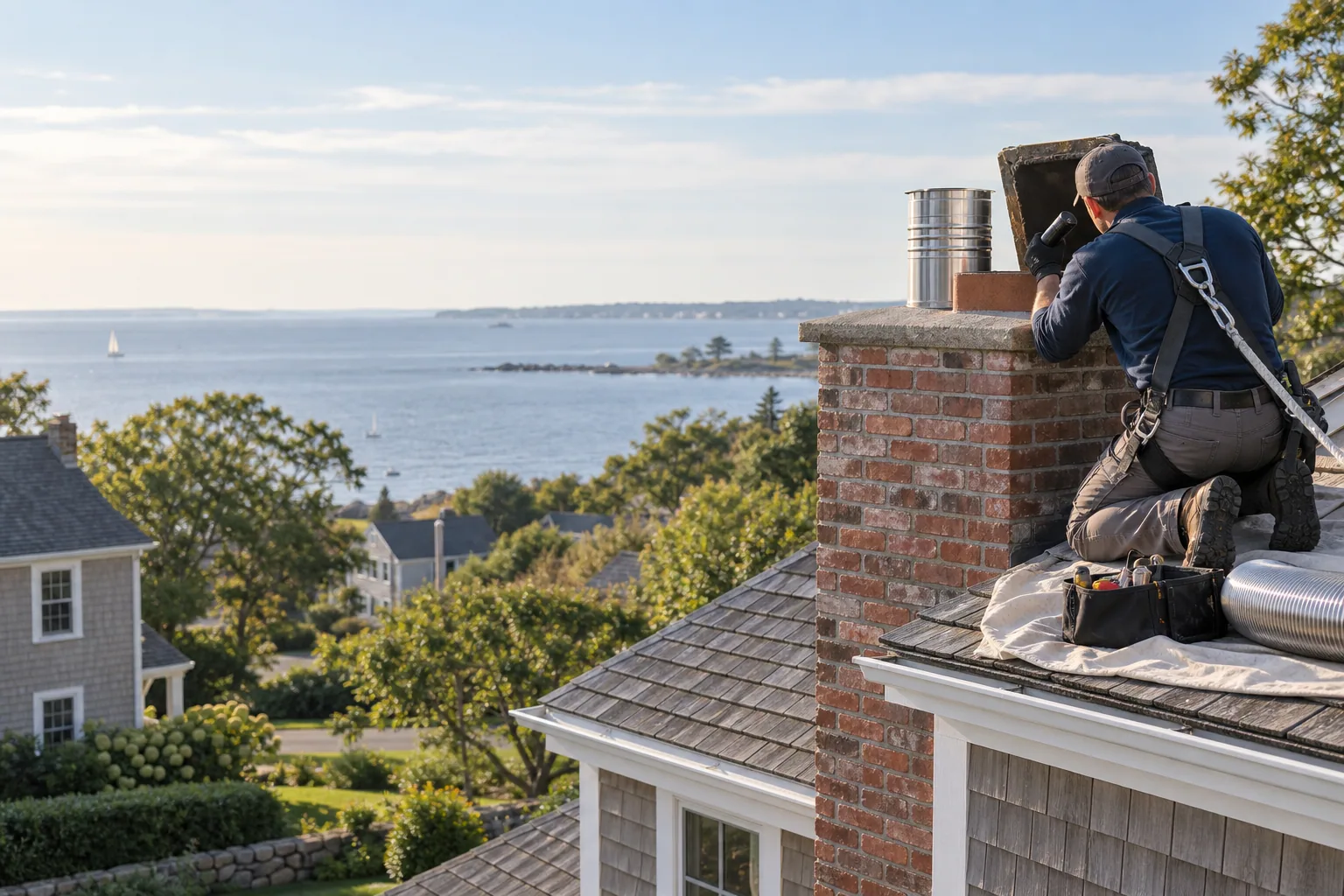
Fairfield Elite Chimney provides independent planning information and quote routing for Newtown, roughly 35 miles from Fairfield. Newtown is an inland Fairfield County town east of Bethel and Danbury, where a historic Main Street village and later subdivisions spread across large glacial-till lots, often lengthening the chimney run a liner has to reach. A qualified local provider must inspect the real appliance, flue and work area before confirming a method or price.
A Newtown property record comes before a product choice
Newtown covers more ground than most Fairfield County towns, and that spread shows up in the housing stock: a compact historic village core sits beside large-lot subdivisions and smaller settlements such as Sandy Hook and Hawleyville, each grown on its own schedule. Before any proposal, list every fireplace, insert, stove, furnace, boiler and water heater on the property and assign each a plain label tied to its room or structure, not to the house as a whole. A village-era home can hold two or three separate masonry stacks added as the building changed hands, and a camera report written for “the chimney” without naming which one becomes useless once a second stack needs attention.
Newtown field notes that should travel with the request
Newtown’s bedrock sits under a layer of glacial till left by the retreating ice sheet, and exposed ledge rock surfaces across many of the town’s larger lots, so a chimney base built against uneven rock can settle differently than one poured on open soil. The village center along Main Street carries homes built well before central heating existed, with masonry flues laid out for open hearths rather than a furnace, boiler or insert added generations later, while the surrounding subdivisions filled in with ranch, raised-ranch and colonial-style houses on much larger parcels than a typical coastal lot. A house set far back from the road on acreage often routes a longer run of connector pipe or a taller stack, and length changes draft and condensation behavior even when the flue’s diameter looks ordinary.
A property with several fireplaces spread across a main house, an addition or a detached garage should have each stack numbered on a simple sketch before the visit, noting which rooms and appliances, if any, connect to each one. Do not assume a fireplace that looks sealed or a flue that appears unused is actually abandoned; a connector can be hidden behind a later renovation, and only a direct inspection confirms whether a passage is active, capped or disconnected. A Level 2 inspection is commonly requested ahead of a Newtown home sale, refinance or insurance renewal on these larger or older parcels, and the written record should name every flue individually rather than summarize the house’s chimneys as one item.
Use local building form to plan access, not diagnose the liner
Send ground-level photographs and describe ordinary access constraints for the Newtown property, including a long gravel driveway, exposed ledge, or a detached garage with its own chimney. Roof pitch, height, landscaping and neighboring structures can affect setup, but they do not reveal hidden joints, corrosion, deposits or clearances inside any flue.
Inspect and label the complete Newtown venting route
Ask the provider to identify the appliance, fuel, input, connector, current liner material, visible dimensions, height, offsets, cracks, gaps, deposits, corrosion, staining and viewing limits for each labeled stack. A useful camera sequence names its direction so a second or third fireplace on a large Newtown lot is never confused with the first. Start with the liner inspection guide and use the Level 2 chimney inspection before any liner method gets chosen on a property with an unfamiliar heating history.
Once every stack on the Newtown parcel carries its own number and matching camera record, the chimney liner installation page picks up from there, covering sizing, insulation, connections and the sign-off that closes out the project.
Keep liner, masonry and water-entry scopes separate in Newtown
A liner is the internal venting passage. Crown, cap, flashing, brick, mortar, smoke chamber, firebox, connector and appliance are related but distinct components. Ask each Newtown proposal to say what is included, excluded and still undecided for every flue named in the inspection record.
Choosing between a stainless sleeve and a poured liner in Newtown
A village-era Main Street flue and a newer subdivision chimney do not automatically call for the same material; the camera findings for that exact passage decide, not the house’s age or its lot size. Compare the stainless steel chimney liner option against the cast-in-place chimney liner option only once the appliance, the flue’s measured dimensions and any existing liner material are written down. A flue that runs reasonably straight and close to round can often accept a flexible stainless sleeve sized to the connected appliance and the length of run a larger Newtown lot can require. A flue that has gone noticeably out of round, narrowed unevenly from old parging, cracked through or lost structural soundness tends to need the cast-in-place method instead, since a poured liner can fill and reshape an irregular passage a sleeve cannot follow safely. Where the inspection finds a flue sound apart from one isolated flaw, check the liner repair guide before assuming full replacement is the only path.
Confirm the current Newtown municipal path
Newtown reviews chimney, venting and appliance work under the Connecticut State Building Code through its own Building Department, and a permit question for a specific parcel should go to that office rather than be assumed from Bethel, Danbury or any other neighboring town. Requirements can change and can differ for internal relining, visible exterior work and appliance replacement, and a property near the Main Street historic district may carry its own review steps for visible exterior changes.
Compare Newtown proposals in homeowner decision bands
Place the same inspection record beside every proposal. Compare inspection and preparation, liner system and components, access and connections, then permits and closeout. The cost guide shows those bands without pretending an online range is a property-specific quote.
Keep the finished Newtown record with the home
Retain the appliance data, before-and-after images, product identity, sizing basis, insulation, connections, permit and inspection record, operating checks, invoice and warranty for every flue that received work. On a property with multiple stacks, sort records by the same labels used during inspection so a future owner or technician can match each document to the correct chimney.
Build a useful Newtown intake packet
Start with the full Newtown address and note whether the house sits in the Main Street village, a surrounding neighborhood such as Sandy Hook, or a larger subdivision lot farther from the center. List each fireplace, insert, stove, furnace, boiler and water heater, and for a property with more than one chimney, note which structure or wing each stack serves. For every active appliance, record the fuel, model information that can be read safely, visible connector route and any known replacement or conversion. Attach earlier camera reports, permits, invoices and product documents instead of summarizing them from memory.
Photograph each chimney exterior, appliance connection and cleanout only from safe standing locations, and keep the images grouped by stack. Note ordinary access facts such as a long gravel driveway, exposed ledge, or limited parking near a detached structure. The provider, not the homeowner, should decide how to access a roof or concealed area safely. These notes help plan a visit; they do not establish any flue’s condition.
Keep symptoms factual until the route is inspected
Dates and operating conditions make observations more useful. Write “odor noticed near the dining room fireplace after rain” or “debris found at the cleanout for the furnace flue” rather than choosing a cause or assuming one stack’s symptom describes another. Similar symptoms can come from different parts of the chimney, appliance, connector or exterior envelope. The inspection and proposal should show which evidence supports the recommended Newtown scope for each flue and which questions remain open.
Review the Newtown closeout before the provider leaves
Match the completed work to the original flue label, appliance and written scope for each chimney addressed. Collect product identity, installation images, connection details, inspection outcome, permit record when applicable, operating checks, invoice and warranty. If work changed after discovery, retain the written reason and revised scope so another qualified person can see what was inspected, what was installed or repaired, and what was deliberately left outside the project on this particular stack.
For follow-up, share the Newtown address, appliance, symptoms and existing records. The site routes the request to a local provider; it does not offer emergency dispatch.
Nearby, Danbury sits just west with a larger downtown mix, while Brookfield adds Candlewood Lake cottages north of Danbury and Ridgefield carries antique Main Street colonials under its own building office, so check the matching guide before carrying a Newtown answer elsewhere. Toward Danbury, Bethel has a smaller village-and-neighborhood footprint where masonry liner planning still begins with the individual flue and its local review. For the rest of this site’s Connecticut coverage, browse the service area directory.
South toward Stepney, Monroe brings wooded lots and postwar exterior masonry chimneys where cap wear and wood-burning insert connections deserve separate inspection notes.
Official and technical sources
- Town of Newtown
- Connecticut State Building Code
- Connecticut Residential Code Chapter 18, Chimneys and Vents
- Connecticut home-improvement guidance
- CSIA relining training overview
Matching an appliance to the flue in Newtown? Compare oil furnace chimney liners and chimney liner insulation as part of the selected system before approving a Newtown scope.
Frequently asked
01Does a Newtown mailing address prove which office handles the work?
No. Confirm the parcel, municipality, appliance and complete work description with the current local authority.
02Can an exterior photo diagnose a Newtown chimney liner?
No. Exterior images help plan access, while the appliance and internal passage require direct inspection.
03Does an older Main Street village home automatically need a poured liner?
No. Village-era construction is a starting clue, not a verdict. A camera inspection of the actual flue shape and condition decides between a stainless sleeve and a cast-in-place system.
04Does a longer driveway or a larger Newtown lot change how the liner is sized?
No. Lot size and access distance affect planning and setup, not the liner size or material, which follow the connected appliance and the flue's measured dimensions.