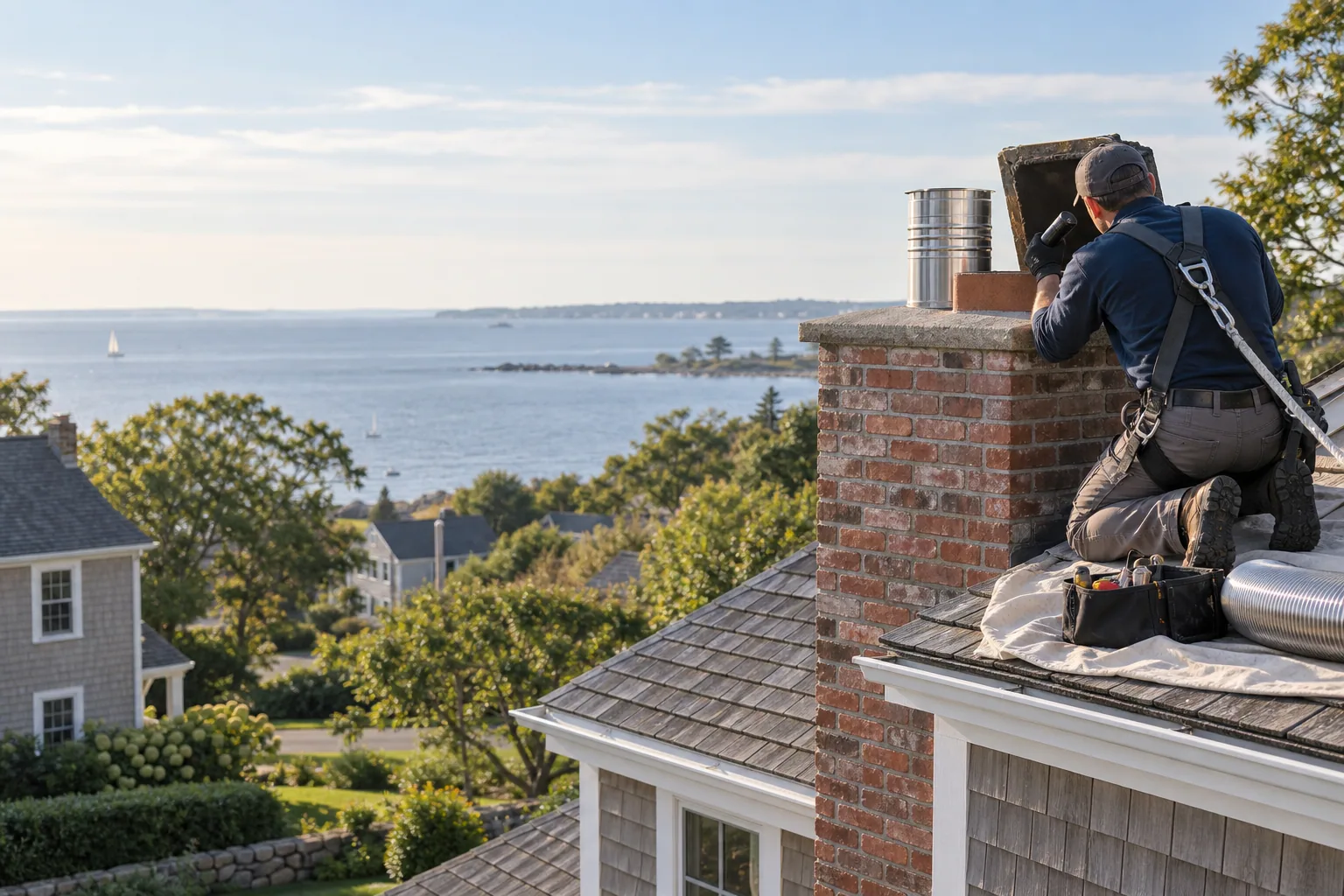
Fairfield Elite Chimney offers independent chimney planning information and quote routing for New Fairfield, roughly 34 miles from Fairfield. This northern Fairfield County lake town sits north of Danbury and borders Brookfield, wrapping around Candlewood Lake and Squantz Pond on wooded, hilly ground. Many of its homes began as 1950s to 1970s lake cottages later converted to year-round living, standing among raised ranches, capes and newer colonials. A qualified local provider needs to examine the appliance, deposits, interior passage and exposed masonry before recommending cleaning, liner work or repairs.
Reopen a New Fairfield lake home before the first fire of the season
A house that sat quiet through the colder months does not come back into use the way a continuously occupied home does. A flue left idle since last season can hold leftover creosote, drifted leaves, loosened masonry grit or an animal that moved in while no one was burning. None of that is visible by glancing up from the firebox, and lighting a fire to find out what happens is not a safe test.
Before arranging a visit, describe how the property is used and what sits inside each hearth. Note whether a lower-level wood stove, an upstairs fireplace or a fireplace insert carries most of the heat, and when the chimney was last swept or inspected if that is known. For a converted cottage, flag any addition with its own hearth and any closed-off opening that may still connect to a passage. These details let the provider trace the actual venting route rather than assume the system matches the cottage’s original layout.
Put sweeping and inspection together after an idle winter
Reopening season is the moment to pair cleaning with a documented look at internal condition. Sweeping clears the accessible deposits that build up with regular wood heat; inspection evaluates what can be seen afterward and records where the view ends. A firebox that looks tidy after a winter closed up says nothing about creosote above an insert or a joint hidden behind a connector.
Use the chimney liner inspection guide to prepare questions about the interior passage, and ask for camera images tied to a named location such as the den insert flue rather than an unlabeled set of closeups. If deposits block a useful view, the proposal should explain that cleaning comes first and another look follows. When an appliance change, a sale or a reported event calls for broader documentation on a reopened property, discuss a Level 2 chimney inspection with the provider so the written record covers the full route.
Lake wind and moisture keep the crown and flashing worth checking
Exposure near open water is part of what makes New Fairfield chimneys worth a close look each season. Wind coming off Candlewood Lake and Squantz Pond drives rain against the stack from angles a sheltered inland chimney rarely sees, and a crown or flashing detail that held for years can open up after repeated wind-driven wetting. Proximity to the water describes that exposure; it does not by itself diagnose a crack, a gap or a damaged liner at one address.
Ask the inspector to document the cap, screening, crown surface and visible flue termination as separate items, then to note flashing condition where the stack meets the roof. A missing or corroded cap can leave an opening at the top, while a worn crown or a lifted flashing lip can admit water on a different path entirely. Each of those findings stands on its own and none of them establishes the condition farther down the passage.
Match any liner work to the stove or insert, not the cottage
A fireplace insert or a freestanding stove changes the appliance sitting in the hearth, but it does not settle the venting route above it. For a New Fairfield home where a previous owner added an insert, gather the model information and any installation paperwork so the inspector can trace the connection and assess the liner, accessible joints, measured dimensions and insulation requirements against the appliance instructions.
The wood stove chimney liner guide covers that appliance-specific planning, while the fireplace chimney liner guide frames the different context of an open hearth. An oversized masonry passage left from a cottage’s original heating is not automatically a suitable route for a hard-used stove. Once the measured route and condition are written down, review chimney liner installation and compare stainless steel chimney liners against cast-in-place chimney liners through the documented findings. Neither the lake-cottage style nor the width of the stack selects the material. Where the inspection finds a passage that is sound apart from one isolated flaw, the chimney liner repair guide helps weigh a limited repair before assuming a full replacement.
Keep masonry repairs separate from water-entry guesses
On a New Fairfield exterior stack, ask the provider to identify cracked crown areas, deteriorated mortar, spalled brick and flashing concerns individually. A stain on an interior wall may prompt that investigation, but the stain alone cannot name the entry point, especially where lake wind pushes moisture in from more than one direction. Record when the mark appeared, whether it followed a storm and whether the appliance was running, and keep photos from the same indoor spot over time so the history is easy to follow.
A masonry proposal should name the affected section and the planned repair rather than promise to stop every leak. Repointing joints, rebuilding a crown, replacing a cap and correcting flashing are different tasks that each answer to their own finding. Keep liner recommendations in a separate part of the scope so exterior repairs are never read as approval of the venting passage.
Plan access across a wooded, hilly lake lot
New Fairfield lots often run up or down a slope, with narrow lake roads, shared drives, mature trees and limited turnaround close to the house. Share those practical constraints before the appointment, including any branches near the roofline or tight footing on a grade. Ground-level images help; homeowners do not need to climb, move an insert or open concealed construction to assemble an intake packet. The provider should decide how to reach a roof or hidden area safely and document anything that stays out of view.
For proposed liner, masonry or appliance work, confirm the current parcel-specific permit and inspection path with New Fairfield’s local building authority rather than carrying a neighboring town’s process onto the address. Ask who will handle required submissions and inspections, and include that responsibility in the accepted proposal.
Compare a full proposal and keep the New Fairfield record
Compare proposals using the same observations and inspection record, and ask each provider to separate sweeping, further investigation, liner work, masonry repairs and completion checks. The chimney liner cost guide explains the scope factors that belong in that discussion without treating a general range as a property-specific quote. A written estimate should identify unresolved conditions and how any discovery will be handled before extra work proceeds.
After completion, retain the report, appliance identification, product details, photos, any required municipal records and operating guidance, and match each document to the fireplace, stove or heating flue it concerns. For help organizing the next step, send the New Fairfield appliance history and chimney observations. This site routes assessment requests; an on-site provider must establish condition and suitability for use.
Nearby guides for Danbury, Brookfield and Ridgefield cover adjoining inland and lake settings, and just north Sherman continues the northern arm of Candlewood Lake with its own antique farmhouses and weekend homes left idle between visits, while New Fairfield keeps the seasonal reopening cycle, lake-driven moisture and heavily used stoves and inserts central to this guide. Keep each property’s findings and local review questions with its own address, and browse the service area directory for the rest of the site’s coverage.
Technical references
For the code and consumer context behind a proposed scope, consult the Connecticut State Building Code resource and Connecticut home-improvement guidance. These reference links also appear in the neighboring town guides; confirm current requirements for the actual project.
Matching an appliance to the flue in New Fairfield? Compare oil furnace chimney liners and chimney liner insulation as part of the selected system before approving a New Fairfield scope.
Frequently asked
01I'm reopening a Candlewood Lake home after the winter. What should happen before the first fire?
Request an inspection and sweeping before lighting anything. Months of no use can leave creosote from last season, settled debris or animal entry that a quick look from the hearth will not reveal, so have the provider examine the flue, damper and termination first.
02Is creosote left from last season safe to burn off?
No. Burning does not clear creosote and can increase the hazard it already presents. Leave the appliance unused and ask the provider to measure the deposit, remove it by sweeping, then inspect what the cleaning exposes.
03The damper sticks after the house sat unused all winter. Can that wait until later?
Report it before the visit rather than forcing it. A damper that binds can point to corrosion, trapped debris or warping, and the provider should check it alongside the cap and upper flue instead of treating it as an isolated quick fix.
04Can a photo tell whether lake wind and rain have damaged my crown or flashing?
A ground-level photo helps plan access but cannot confirm crown cracks or flashing gaps. Wind-driven moisture off the water settles in places an exterior image misses, so those surfaces need a direct look during the visit.
05My insert ran hard through last winter. Does heavy use change what the inspection covers?
Tell the provider how often you burned and the fuel used. Heavy wood stove or insert use builds deposits faster and makes the connector, liner condition and termination more important to document than a single seasonal check would suggest.