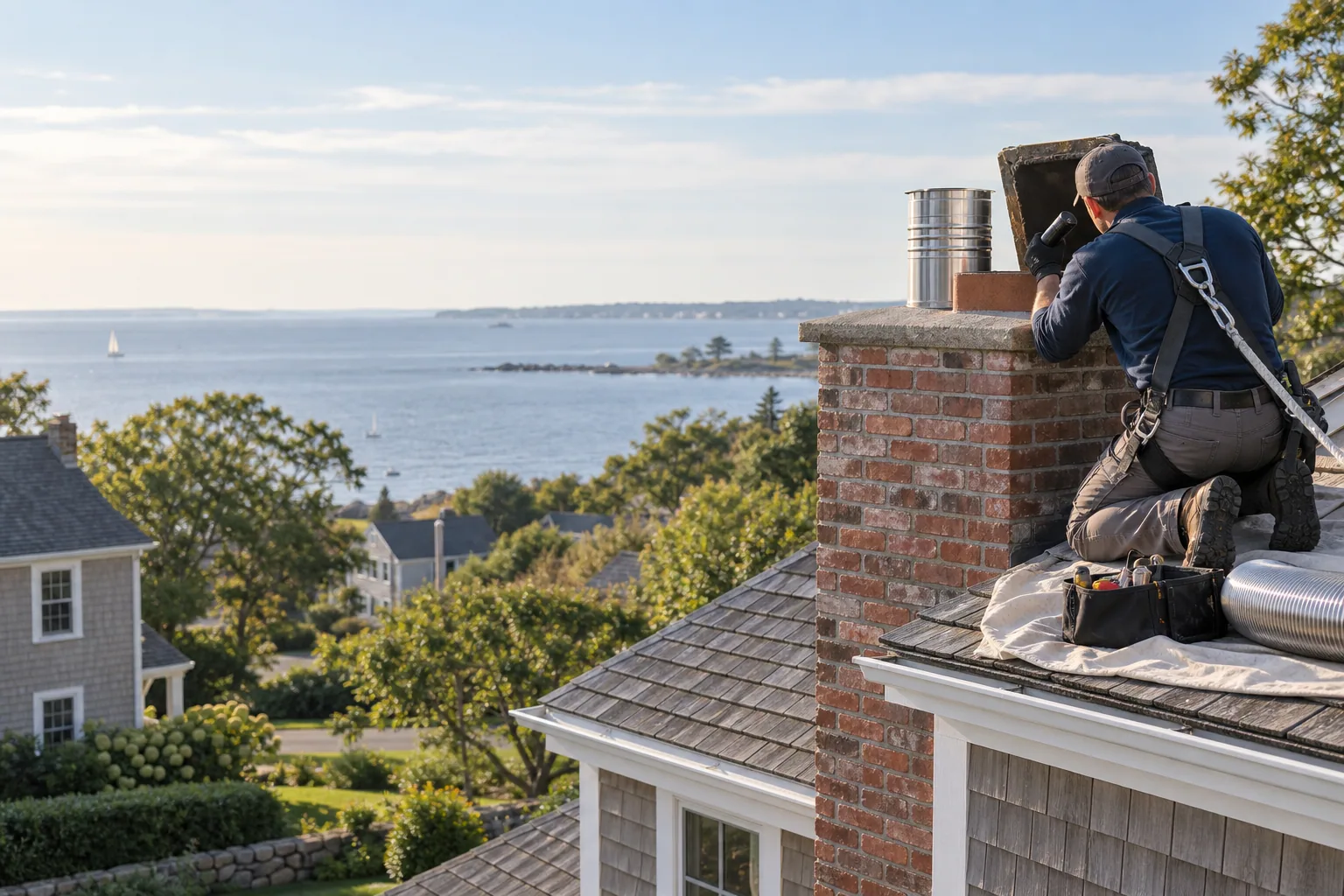
Fairfield Elite Chimney shares independent planning notes and routes quote requests for homeowners across Greenwich, a Sound-front town sitting roughly 22 miles down the shoreline from Fairfield. Between Byram, Cos Cob, Riverside, Old Greenwich and the backcountry estates further north, lot sizes and chimney counts vary enough that no single description fits every address. Nothing here substitutes for a licensed provider walking the property, examining the connected appliance, and tracing the flue before naming a method, a safety finding, or a price.
Why a Greenwich estate needs its own chimney paper trail
Properties along the Sound and in the backcountry often carry a main house plus a guest cottage, pool house, or converted carriage house, and each outbuilding can have its own flue serving a different appliance. Walk the lot and note every fireplace, stove, furnace, boiler, and water heater that ties into masonry, along with connectors, thimbles, cleanouts, and roof caps visible without climbing. Flag which passages are clearly in use, which are questionable, and which look abandoned, rather than guessing which chimney serves which appliance.
Byram to backcountry, the details shift
Byram, Cos Cob, Riverside, and Old Greenwich sit close to the water, while estates further inland toward the New York line spread across larger, wooded lots carrying two or three separate stacks. A tall chimney on a backcountry colonial says nothing about what liner sits inside it, just as a modest shingle-style cottage near the Old Greenwich harbor can hide a cracked flue behind a clean facade. Many of these homes switched from oil heat to gas at some point, and the liner installed for an oil burner is not automatically the right size or material for the gas appliance that replaced it. Greenwich reviews chimney, venting, and appliance work through its Building Department under the Connecticut State Building Code, so a permit question should go to that office rather than be assumed from a neighboring town’s rules.
When a fuel conversion changed which appliance feeds which chimney, carry that history into the inspection request so the camera work targets the passage that matters now. Give each stack on the property a number on a simple hand sketch, and carry those numbers through the proposal, permit paperwork, and finished file, so nobody confuses the guest house flue with the one serving the main kitchen fireplace.
Access photos tell the crew where to park, not what’s wrong inside
Share street-view and yard photos along with notes on gates, long driveways, tight turnarounds, or waterfront setbacks that might affect how a crew sets up. Roofline, pitch, and nearby trees matter for planning a safe approach, but none of that shows what a camera finds inside the flue once someone climbs up and looks.
Mapping every flue before anyone touches a liner
Have the technician name the appliance, fuel and input rating, the connector, the liner material already in place, and the dimensions, offsets, cracks, gaps, deposits, and corrosion the camera catches, plus wherever the view runs out. Start from the liner inspection guide, and lean on the Level 2 guide whenever a closing, refinance, or major system swap calls for the fuller written record. Because waterfront and backcountry Greenwich sales move at a steady pace, a Level 2 report tied to each numbered flue often satisfies a buyer’s attorney or inspector.
A liner problem and a masonry problem aren’t the same repair
The liner only covers the passage gases travel through. The crown, cap, flashing, brickwork, mortar joints, smoke chamber, firebox, connector, and appliance are neighboring parts, not the same part, even though a single quote sometimes lumps them together. Push every Greenwich bid to spell out what it touches, what it skips, and what still needs a decision.
For the full project sequence, review chimney liner installation and the Fairfield replacement decision guide.
Choosing between a stainless sleeve and a poured liner
Owning more than one stack on a Greenwich property doesn’t tell anyone whether a sleeve or a poured system fits better, so hold off on that call until the camera work is finished. Weigh a stainless steel chimney liner against a cast-in-place liner once the appliance, the flue’s real dimensions, and the material already inside are on paper. A straight or mildly offset flue, including the narrower passage many gas conversions call for, usually takes a flexible stainless sleeve, while a flue that’s badly out of round, cracked through, or structurally shaky points toward cast-in-place work instead. If the inspection turns up a liner that’s basically sound with a localized flaw, the liner repair guide might close the gap without tearing out and starting over.
Checking with the Greenwich Building Department first
Regulated chimney, venting, and appliance work in Greenwich runs through the Building Department, and that office, not a neighboring town’s rules, should confirm whether a specific parcel and scope need a permit before anyone starts. Rules shift over time and can land differently on relining work done entirely inside the flue versus visible exterior changes versus a full appliance swap tied to an oil-to-gas conversion. Treat every Greenwich permit answer as tied to this address and this scope, not as a blanket rule carried over from somewhere else.
Lining proposals up against each other
Lay the inspection record next to every bid received. Separate what each one charges for inspection and prep, for the liner system and its parts, for access and connections, and for permits and closeout. The cost guide breaks spending into those same bands without pretending a generic online figure doubles as a quote for this specific chimney.
Putting together a Greenwich intake file
Start with the full street address, say whether the lot holds a single residence, a multifamily structure, or something else, and flag any guest house, pool house, or carriage house with its own flue. List every fireplace, stove, furnace, boiler, and water heater that might tie into masonry, and for each active appliance note the fuel type, model information that’s safe to read, the visible connector path, and whether it replaced an older unit, especially an earlier oil burner swapped for gas. Pull together any earlier camera footage, permits, invoices, or product paperwork rather than paraphrasing them from memory.
Take ground-level photos of the chimney exterior, the appliance connection, and the cleanout, staying on safe footing, and jot down access notes, gates, a long private drive, a shared road near the water, seasonal caretaker schedules, or tight parking. Let the provider, not the homeowner, judge how to safely reach a roof or crawlspace. None of this settles what’s happening inside the liner; it only sets up the visit.
Describe symptoms, don’t diagnose them
Note the date and what was running at the time, such as “smelled something after the furnace kicked on” or “found debris near the cleanout,” instead of naming a cause before anyone has looked. The same symptom can trace back to the chimney, the appliance, the connector, or a leak in the exterior envelope. A solid inspection and proposal should point to the evidence behind the recommended Greenwich scope and flag whatever is still open.
Closing out the job
Check the finished work against the original flue label, the appliance, and the scope written down beforehand. Gather the product’s identity, before and after photos, sizing basis, connection details, the inspection findings, the permit record where one applies, startup checks, the invoice, the warranty, and any monitoring instructions. If the scope changed once work started, keep the written explanation for why. Years later, an owner, a buyer’s inspector working from a Level 2 report, or another technician should be able to open that file and see what was inspected, what was installed or fixed, and what was intentionally left outside the project.
To move forward, send the Greenwich address, appliance details, symptoms, and any existing records. The site forwards that request to a local provider; it isn’t an emergency dispatch line or a remote diagnosis service.
Nearby, Stamford, Darien, New Canaan, Norwalk and Westport each answer to their own parcel records and local rules, so check the matching guide before carrying a Greenwich answer somewhere else. The complete areas we serve list covers every Fairfield County town this site documents.
Official and technical sources
- Town of Greenwich
- Connecticut State Building Code
- Chimneys and Vents, Chapter 18 of the Connecticut Residential Code
- Connecticut home-improvement guidance
- CSIA relining training overview
Matching an appliance to the flue in Greenwich? Compare oil furnace chimney liners and chimney liner insulation as part of the selected system before approving a Greenwich scope.
Frequently asked
01Does a Greenwich mailing address prove which office handles the work?
No. Confirm the parcel, municipality, appliance and complete work description with the current local authority.
02Can an exterior photo diagnose a Greenwich chimney liner?
No. Exterior images help plan access, while the appliance and internal passage require direct inspection.
03Does owning several Greenwich stacks change how a liner is sized?
No. The number of stacks can affect scheduling and access, but the connected appliance and flue dimensions decide the liner size and material.
04What should be included with an assessment request?
Share the address, appliance and fuel, symptoms, prior reports, known liner history and ordinary access notes.